Free Trade Unionism in the International Context
Anthony Carew
Reader in International Labour Studies University of Manchester Institute of Science and Technology
Paper prepared for the Conference on The International Labour Movement on the Threshold of Two Centuries
Stockholm October 24-25, 2002
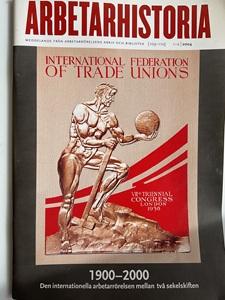
A Swedish translation Stride nom en oberoende internationalism: Dem fria fackföreningsrörelses inre och yttre fiender appeared in the Swedish labour movement’s journal Arbetarhistoria, 1-2, 2004 to commemorate its 100th anniversary
"Free trade unionism" is one of the great rhetorical expressions of the labour movement. The rights of "free" trade unions are what are denied today in countless national situations in an international trading context that contrives to pit workers against one another in the proverbial race to the bottom. In these situations, free trade unionism is a hurrah term: we in the labour movement are all free trade unionists now.
However, it is worth recalling that until just over a decade ago use of the word "free" in this context was highly controversial in some labour circles. It was regarded as tendentious, a loaded adjective that cold warriors in western capitalist society had appropriated for propaganda purposes. "Free" trade unions were what communist organisations of the same name were not.
That battle between the proponents and critics of free trade unionism is now over. It was comprehensively won by the former, although occasional faint echoes of the old conflict can be heard in quarters where the International Confederation of Free Trade Unions (ICFTU) and its adherents have always been seen as an inferior form of trade unionism. Some retain a vague nostalgia for the more full-blooded trade unionism that the ICFTU's rival, the World Federation of Trade Unions (WFTU) is supposed to have stood for.
For those who have come of age since this cold-war battle was in progress, or who vaguely feel that a more vigorous form of trade unionism lost out with the collapse of communism, it is worth reviewing the notion of free trade unionism in various historical contexts.1 The focus of this conference is on issues that were important to the labour movement at the start of the last century as well as the present one. I suggest that the essentials of free trade unionism were of importance in both of these periods: indeed that they are timeless.
When the founders of the ICFTU discussed the definition of free trade unionism in 1949, they were not inventing something new so much as distilling the essentials of trade unionism as practised in most developed western countries for at least half a century and, in some cases, for a great deal longer. They not only focused on the problem of government or employer control of the labour movement but all attempts by outside agencies to direct it. Some of the discussants viewed trade union - socialist party links as problematic. And indeed this view did reflect a tension that had been present at the beginning of the 20th century.
Free Trade Unionism and Leninism
It was a consideration when one of the ICFTU's predecessors, the International Secretariat of National Trade Union Centres (ISNTUC), later to evolve into the International Federation of Trade Unions (IFTU), was born in 1901. At that time there were various kinds of union-party relationships in existence. In Britain the unions had emerged and matured as self-reliant organisations but were now creating a mildly reformist Labour Party to act as their parliamentary wing. American unions, whether of the moderate "pure and simple" stripe or the more militant industrial union persuasion, were deeply sceptical about party political ties. In northern Europe the pattern was rather different. In Sweden, where socialist politics preceded strong trade unionism, the two wings of the movement operated in partnership. For many the model was the German situation where a powerful Social Democracy saw trade unions as a subordinate part of a greater movement. But even there by the 1900s the unions had begun to insist on having room to manoeuvre and to shape their own policies, most noticeably over the use of the general strike. In this the German trade unions were reflecting a sentiment shared elsewhere.
It would be fair to say that in the years leading up to WW1 there was a growing recognition in the trade unions that for pragmatic considerations they needed freedom from party influence. This was reflected in the ethos of the IFTU whose establishment gave national trade union centres a vehicle for discussion of purely union matters at international level, free from party influence. Unions might still be closely related to labour or socialist parties, but the relationship was now more one of equals. This was part of the emerging notion of "free" trade unionism.
The assumptions behind this approach to trade unionism were challenged head on in Bolshevik thinking which animated much militant trade unionism after 1917. Lenin's ideas, from What Is to be Done? and the Theses of the Communist International, laid down the parameters for labour organisations adhering to the Comintern and its trade union subsidiary the Red International of Labour Unions (RILU). Unions were to be the disciplined transmission belts of the party whose ultimate point of reference was the Soviet communist leadership in Moscow.
While the IFTU placed its hope in a reformed capitalism, with matters of concern to workers regulated by the new International Labour Organisation, communist-led unions sought either to destroy the "yellow" trade unions of the IFTU or to infiltrate and take control of them in pursuit of aims determined on high, the choice of tactics depending of the foreign policy needs of the USSR. Typically it meant a disciplined minority seeking to act as a drive mechanism in relation to a larger, heterogeneous membership.
A persistent image from the period, one cultivated in communist historiography, views the situation in terms of action and struggle and contrasts the studied moderation of the "Yellow International" with the stirring militancy of communist-led organisations attracting as they certainly did some of the more colourful and dynamic figures in trade unionism. But there is another point of distinction that has to do with rival concepts of leadership and democracy. The transmission-belt relationship between unions and party, the application of cadre discipline and the precepts of democratic centralism introduced a new dimension to trade unionism. This is not to say that former paragons of democratic virtue in the labour movement ceased to be such as a result of communist practice. But the manipulation of union structures by a disciplined minority for ends not shared by the majority of members did undermine democratising tendencies previously to be found in versions of social democracy and syndicalism. One of the interesting aspects of the Bolshevisation of the British Communist Party was the way in which people formerly at the forefront of attempts to democratise trade unionism now practised a style of leadership quite at odds with their earlier principles.2 A consideration of norms of democratic practice is an important way of distinguishing between free trade unionism and unions of the Leninist model.
A United Labour Movement - the WFTU Interlude
In the years following WW2, perceptions of free trade unionism and the battleground surrounding it were naturally influenced by this fraught inter-war experience. But they were also affected more directly by developments in wartime and immediately afterwards that took the labour movement on a switchback ride. These were the years when the appearance of international trade union unity emerged in the guise of the WFTU, only to be shattered within four years when the leading western trade union centres withdrew in 1949 to form the ICFTU as an explicit grouping of free trade unions. The events that led to the creation of the WFTU and its subsequent split are too complex to describe in detail, but some basic points can be made.
International trade union unity was very much a by-product of the wartime anti-fascist alliance and the projected post-war settlement in which the United Nations would occupy centre stage. The WFTU was to be a central actor in this scenario: an all- embracing agency linking unions of various kinds that would represent world labour within a United Nations whose Economic and Social Council would equal in status the Security Council. This role, essentially a political one, never materialised. Nor, in narrower trade union terms, could the WFTU lay claim to any major achievements. Its attempt to establish a modus vivendi with the International Trade Secretariats (ITS) was blocked: key figures among the ITS leadership never believed in the possibility of working with the Soviet trade unions. Consequently the Federation failed to develop a mechanism through which it could have an input into day-to-day trade union campaigns in industry.
As the cold-war climate affected the trade union world, mutual suspicions permeated the Federation while disagreements began to hamper routine business and sap the spirit of unity. Whether on matters such as the organisation of a conference of trade unions from dependent territories or an agreed statement on the Japanese trade union situation, mistrust began to paralyse its inner workings. Serious allegations of pro-communist factionalism on the part of the general secretary, and ideological bias in Federation publications, increased steadily from as early as 1946 until discussion of such charges took up the bulk of the time at executive board meetings. And all hope of meaningful trade union unity finally evaporated in a bitter battle over the Marshall Plan from 1947. Soviet government opposition to the plan led directly to the creation of the Cominform as a means of tightening discipline in communist ranks and so directing a campaign among trade unions, firstly to block any discussion of the Marshall proposal within the WFTU and then, once the scheme was operational, to sabotage it by means of direct industrial action.3
For the leaders of the western-based trade union centres that now withdrew to form the ICFTU, the entire experience was proof that Soviet and eastern bloc trade unions were not free from government control. Equally it was apparent that communist-led unions in the west -- notably in France and Italy -- were prepared to accept the discipline imposed by Moscow through the Cominform. The founders of the ICFTU now set about defining free trade unionism. The discussion was led by the American Federation of Labour (AFL) which had refused to join the WFTU precisely because of Soviet trade union participation and was delighted to have been proven right on the impossibility of co- operation with the communists. There was agreement that ICFTU rules must preclude membership by organisations that were creatures of the state, whether fascist or communist. Confessional trade unions were deemed to be eligible for membership provided they joined individually and wound up their own Christian international (a condition that they rejected). The AFL wanted the definition to emphasise the primary function of trade unions as collective bargaining agencies and proposed a formulation that spoke of freedom from domination by "political parties, government and employer". However, to accommodate the situation in the Nordic countries, New Zealand and Britain, where the labour movement operated in partnership with social democratic governments, the less specific phrase "independent of external domination" was finally adopted.
Free trade unionism was thus defined more in terms of what was not acceptable than what was desirable. It implied the kind of trade unionism that was practised in developed western countries, but even here there was scope for different interpretations. How much autonomy was required to pass muster? In terms of politics and a traded unionism, how much inter-linking was acceptable? In a vague sense freedom evoked democracy -- but "democracy" could cover a multitude of different practices within trade unions. In matters of finance, how independent did unions need to be? Could free trade unions accept any financial assistance from outside bodies? Did assistance in kind from employers negate free trade union principles?4 In terms of self-sufficiency, were unions that had grown up organically from the base "freer" than those constructed (artificially?) from the top down, perhaps to head off the growth of an undesirable communist organisation? More generally, was free trade unionism simply to be judged in terms of form -- processes and administrative arrangements -- and unrelated to substantive aims and policies? Where did a formally democratic business union whose policies were largely indistinguishable from those of employers register on the scale of "freedom"? Indeed in the context of the Cold War, with anti-communism an ever-present force, some versions of free trade unionism simply equated it with a generalised support for "the West" and agencies such as NATO5, acceptance of market economics, constitutional behaviour (as with support for parliamentary gradualism over direct action) and, more generally, moderation over militancy. Clearly some versions of free trade unionism were more demanding than others, and yet at root the basic distinction between free and "unfree" was still important.
Once up and running, the ICFTU set itself in opposition to Spain's fascist unions and the Peronist movement in Latin America as much as the communist unions of the Soviet bloc. But inevitably it was the latter and its international trade union agency the WFTU that commanded most attention. Reduced to a core membership of Soviet, Chinese and eastern European trade unions, and with but a handful of affiliates in the west -- notably in France and Italy -- the WFTU was shunned by the ICFTU, its routine calls for joint action rejected. Contact with the WFTU was the ultimate taboo, always out of the question.
The Ongoing Dilemma of "Contacts with Communists"
However, by the early 1950s certain situations began to present themselves as grey areas, testing the neat compartmentalisation of free and controlled trade unions and the policy positions that derived from this. A major test case was posed by developments in Yugoslavia, a renegade regime in Moscow's eyes, which had embarked on a new economic model based on self-management and whose unions had recently been expelled from the WFTU. The question facing the ICFTU was whether it was acceptable for affiliates to send fraternal delegations to Yugoslavia. Various arguments were advanced. Some ICFTU members justified their dealings with the Yugoslavs on grounds of seeking the return of prisoners of war. Others denounced such fraternisation as long as Yugoslav trade unionists were in prison for opposing the regime. Some believed that it was necessary to talk with the Yugoslavs at trade union level just as western governments were in dialogue and wooing Yugoslavia with economic aid. Others took the position that while government to government contacts were necessary in the interests of peace, there was no justification for free trade unions to lend credibility to government-controlled agencies.
Such differences pointed to an incipient rift between the purist notion of free unions as advocated by the AFL -- no contacts with communism under any circumstances -- and the more flexible approach of many other centres especially in Europe. The leaders of the latter were generally no less anti- communist in outlook, but in specific situations they were willing to fudge the issue and make pragmatic compromises. Many other cases would arise in years ahead in which arguments similar to those aired in the Yugoslav situation would feature. And tension between the purist and the pragmatic approach to contacts with communism would become a permanent feature of the politics of the free trade union movement.
Other ingredients added to this growing rift. Within the AFL there was a belief that free trade unionism was an ideal to be pursued with missionary zeal. In practice that implied the need to take the fight to the enemy behind the iron curtain - effectively to participate in intelligence operations of the CIA.6 By contrast, many unitary trade union centres in Europe included communist members who, though in a minority, might exercise considerable political influence and who regarded the WFTU-ICFTU split as undesirable and unjustified. Such groups could not easily be ignored, and often exerted strong pressure on leaders to engage in east-west dialogue and exchange visits. Drawing on this factor, the main international objective of the Yugoslav Federation of Trade Unions was to act as matchmaker in the hope of effecting an ICFTU-WFTU reconciliation.
In these circumstances traffic in exchange visits grew significantly throughout the 1950s and 1960s. The ICFTU struggled to maintain a consistent free trade union policy among its affiliates, but it had no power to compel them to desist from contacts with the communists. It tried persuasion, pointing out how visits to the eastern bloc often delivered a propaganda advantage to communism. If that failed, it would urge affiliates to press home vigorously the values of free trade unionism in contacts with communists and to use visits as an opportunity to gather information on the condition of workers and the general political situation in the country visited. Yet there was little confidence that that this approach would succeed. Visitors from the west were rarely allowed close access to ordinary citizens and were unlikely to have their free trade union views reported in the press. Likewise, their hosts would allow them to hear and see only what the authorities wanted, and inexperienced and sometimes naive visitors would bring home the message and images that the hosts wanted to promote in the west.
The ICFTU's failure to hold a firm line in this area was at the heart of the growing sense of disillusionment of the American trade union leadership who feared that the free trade unions were on a slippery slope leading to reconciliation between the ICFTU and WFTU, and with it a sacrifice of fundamental trade union principle. They pointed out that in all sorts of fora, a mixture of guile and aggressiveness on the part of the communists and a lack of firmness on the part of free trade unions resulted in loss of ground to the former. This might be in the vital arena of the ILO where the free trade unions had failed to exercise discipline in blocking the seating of Soviet and Eastern European workers' delegates, or at grass roots level in countries such as France, Italy and Japan where communist ambitions to gain ascendancy in the labour movement through united front tactics were sometimes condoned by ICFTU affiliates who saw the tactic simply in terms of marshalling the collective strength of workers in the face of that of employers.
Eventually the internal tensions within the ICFTU could no longer be contained, and in 1969 it suffered a major blow to its organisational strength when the AFL-CIO, its largest affiliate, withdrew largely out of dissatisfaction with the Confederation's failure to halt exchanges with communist organisations. Indeed by the late 60s the flow of contacts had become a flood. Those participating were no longer merely from the odd union that happened to have a Soviet- sympathising general secretary, but were from the central confederations themselves, led by the most senior figures in the TUC, DGB, LO etc. And the language of their joint statements with communist counterparts suggested a much greater interest in rapprochement and the restoration of permanent relations. In the case of the German trade unions, diplomacy with their Soviet counterparts would soon become an integral part of Ostpolitik. In Italy organic unity between communist and non-communist unions was beginning to crystallise (though interestingly here the PCI was against the development, fearful that the communist line would be diluted).
All of this was part and parcel of the growing spirit of détente. At the same time developments in several eastern bloc countries, most notably Czechoslovakia, reflected civic pressures in favour of liberalisation. In Czechoslovakia the driving force was the trade union movement which had rejected the subordinate, transmission-belt relationship with the Communist Party. The Prague Spring of 1968 was the direct result of this pressure. And at this point, some American unions such as the United Autoworkers (UAW) now sent high-level delegations to dialogue with the Czech unions and then on to Moscow for talks with Soviet trade union secretary Shelepin. 7 Even when the Dubcek administration was brought down following the Warsaw Pact invasion, the Czech trade union movement remained a strong force for almost a year. In this period of brief promise, free trade union leaders, including bitter opponents of communism, argued that continuing contacts were at least justified with the unions of Czechoslovakia, Romania and Yugoslavia, if not in East Germany, Poland and the USSR.8
As long as increased liberalisation of communism seemed a possibility, all but the most inflexible proponents of free trade union purity could justify some efforts at dialogue with the east. Within the ICFTU a sub-committee on "Contacts With Communism" originally created to seek ways of enforcing the "no contacts" policy, effectively abandoned this and settled for recommending a fall-back position in which bilateral contacts between communist and non- communist centres would be tolerated. Only multilateral links, especially between the ICFTU and the WFTU remained beyond the pale.
The Prospect of Organic Unity in Europe
A significant new development in the early 1970s was the steady move by the ICFTU's European affiliates to replace the Confederation's European regional structure with a free-standing, autonomous organisation capable of embracing confessional and communist unions alongside ICFTU affiliates. An important factor driving this process was the need to strengthen the trade union voice within the European Community. But beyond the possibility of unification of western European centres, there was more ambitious talk of opening up membership to the unions of the Soviet bloc. Shelepin of the Soviet AUCCTU pressed the case for membership by his and other eastern bloc centres at a meeting with the DGB president in Moscow in 1972.
The establishment of this new European body in 1973 was the occasion of a fierce internal struggle within the free trade union camp. The German trade unions made a sharp distinction between, on the one hand, east-west trade union diplomacy aimed at reducing international tension and, on the other hand, institutional links between communist and free trade unions. The former was acceptable: the latter were not. Thus prior to the founding congress, the DGB led a last-ditch attempt to ensure that the new organisation remained firmly within the ICFTU camp, with the word "free" retained in the title. But in the end, proponents of a clear break with the ICFTU, both constitutionally and symbolically in terms of nomenclature, won the day. The new body became the European Trade Union Confederation (ETUC) without any reference to it being "free" or "democratic”. Nor was there to be any organic link with the ICFTU. The DGB had to content itself with a note in the preamble to the constitution recording that all the founding members belonged to the ICFTU. Even that meagre consolation prize would be dropped a few years later.
The Christian unions were allowed to join shortly afterwards, and within 18 months the Italian communist-dominated CGIL was also admitted. However, its application to join was hotly contested, opposition again being led by the DGB. But the CGIL had the strong support of the non-communist Italian unions with whom it was now in a federal relationship. And to minimise opposition from those who feared that this was the thin end of the wedge leading to a link-up with the WFTU in Europe, the CGIL scaled down its relationship with the Federation to "associate membership". This fudged the principle that WFTU membership was incompatible with free trade unionism, but it was enough of a move to satisfy a majority of affiliates including the British and Scandinavians. In truth, for the free trade union camp, CGIL was always likely to be the most acceptable of the communist centres. It had long been critical of WFTU policies and was a proponent of greater pluralism within this centrally directed body. Those fearful that the CGIL would now form the basis of a communist bloc were mollified to discover that its adoption of "associate membership" in the WFTU had seriously damaged its relations with the French communist CGT. The two centres would now have no formal contacts at general secretary level for the next 14 years.9
The shock waves from this development were felt around the world. Yet it was just one in a series of events that seemed at the time to threaten the basis of free trade unionism. Responding to a 1972 proposal from East European centres, the British TUC took up the idea of an All-European Trade Union Conference, and in a series of meetings with Soviet and other eastern bloc unions, laid plans for such a conference in January 1974. The ultimate objective of the British was to bring about reconciliation between the ICFTU and the WFTU, and it was now prepared to entertain the kind of multilateral gathering that ICFTU policy had always ruled out.10 But other western centres, including those from Germany and Sweden, were alarmed at the haste with which this momentous change was being planned and they were anxious that the meeting should not set any major precedents.
Outmanoeuvring the TUC, they ensured that the east-west gathering would be convened by the Workers' Group of the ILO (which the ICFTU controlled, its members providing both the chairman and secretary) as a European regional conference of the Organisation. As such it could be represented as no more than a routine meeting of the ILO, rather than a path-breaking encounter between ICFTU and WFTU unions. The German unions also insisted that the agenda be restricted to non-contentious, technical issues rather than "high politics", and that there be no proposal to establish permanent machinery for an ongoing relationship.11 While much of this politicking was about symbolism, the stakes were high and the outcome would be of potentially enormous significance to the parties on both sides of the struggle.
The DGB's efforts were largely successful and when the one-day conference was eventually held in Geneva discussion was confined to generalities. The TUC and AUCCTU did succeed in winning support for holding another such conference the following year, but this fell short of creating the permanent liaison body that they wanted, although a succession of such ad hoc conferences might be represented as a step in that direction. In fact, four more of these gatherings took place between 1975 and 1981. All were held under ILO auspices and each time the agenda was restricted to narrow technical issues such as toxic substances or vocational training. Clearly, for some participants there was another agenda that they would have preferred to discuss. Optimists might hope, and pessimists fear, that earnest discussion of health and safety problems or industrial pollution would lead to a political breakthrough, but the reality was that nothing lasting came out of this series of meetings. As the 70s progressed, the climate of détente waned and the prospects for deepening trade union unity diminished. Within eastern Europe the prospects for reforming the official trade unions had disappeared and the parallel movement to liquidate trade unionism's ideological differences had passed its peak.
The changed climate was reflected in ETUC's response to the application for membership by Spain's communist-led centre CCOO. CCOO had been seeking to affiliate since 1973, but its application was not seriously considered until 1980. Though its leadership was clearly communist, it presented itself as an independent centre in that it had never belonged to the WFTU and had spurned that body's proposal that, together with the French CGT, Italian CGIL and Portuguese CGTP it form a communist group in Europe. Moreover, although subject to influence by the Spanish Communist Party (PCE), it claimed that the links between the two did not amount to a "typical " transmission belt relationship. And as for the Spanish communists being a tool of Moscow, it was evident that as a Eurocommunist party, the PCE was not in good standing with the Soviet communist leadership which was then engaged in a vigorous campaign against the party's leaders.
Yet when the CCOO application was considered in the ETUC it was met with fierce resistance by the Spanish socialist centre UGT and the German DGB. The former insisted that CCOO was still effectively under PCE control and noted that one tendency vying for influence within the centre was strongly pro-Moscow. The DGB invoked the spectre of CCOO and the CGIL forming the basis of a communist bloc within the Confederation. Another factor was that at this juncture the AFL-CIO was about to re-join the free trade union mainstream as an ICFTU member, but had hinted that membership of ETUC by CCOO might cause it to re-think its plans. Influenced by this possibility, the DGB now threatened to withdraw from the ETUC if CCOO were admitted. The decisive effect of this was to lock the ETUC door to the Spaniards. Along with the CGT and the Portuguese CGTP whose applications for membership were also rejected, they would have to wait a decade until after the fall of communism before securing ETUC affiliation.12
State-Controlled Unions in the Non-Communist World
Spain
The communist regimes in the USSR and eastern Europe constituted the biggest challenge to free trade unionism. For most of the 40 years following the onset of the Cold War, there was virtually no scope for any form of free trade unionism to exist, and contacts with these countries inevitably meant contacts with the official regime. Elsewhere, in the non-communist world, there were scores of situations where governments influenced or controlled the trade union movement. Sometimes totalitarianism was complete. In other cases there might be some scope for assisting oppositional trade unions, whether operating openly or underground.
In Spain up to the late 1950s trade unions were as tightly controlled as in the eastern bloc. The interesting difference is that while many western unions sought contacts in the soviet bloc, there was no equivalent attempt to dialogue with Spain's corporatist unions. It suggests that for some there were ‘good dictatorships’ and ‘bad dictatorships’. As in the case of the communist bloc, the ICFTU was consistent in its total opposition to the Franco regime. It lobbied to keep Spain isolated from the international community, whether in terms of membership of the OEEC, NATO, the ILO or the EEC. Spain's record in denying trade union freedom was constantly challenged in the ILO and the UN. And from the late 1950s, the ICFTU began to send representatives into the country, in support of the UGT in exile, to make clandestine contacts with anti-Franco activists and to fund opposition activities. In the last decade of the Franco regime, the Confederation was increasingly active inside Spanish borders, financing the courtroom defence of trade unionists on trial and helping to organise workers and works councillors associated with UGT.
Africa
In Africa the free trade union emphasis during the colonial era was in assisting organised labour's leading role in the movement for independence. To a large extent this involved support for a political form of trade unionism. In practical terms it meant establishing national centres with sufficient prestige and resources to be able to negotiate with the colonial powers. In the context of a concurrent battle for position with communist elements, these ICFTU-backed centres were often created rapidly on a top-down basis. It was a case of asserting leadership of labour at the national level as a first priority, and only as a second concern turning attention to strengthening the infrastructure -- the cultivation local branches, a stable dues-paying membership and means of representing members at work. Within the ICFTU this sometimes forced, artificial element in the movement led to major disagreements over whether or not it was consistent with free trade unionism. Was the primary role of free trade unions to campaign for national self-government under a non-communist banner, or were they organisations that prioritised economic improvements for members. The TUC (admittedly identified with a colonial power on the defensive) criticised African unions for being "too political", while the ICFTU general secretary admitted that the external financing of recently created national trade union centres bred an element of corruption.13 The Americans, great believers in the economic role of trade unions at home, were strong supporters of political trade unionism in Africa as a means of fending off communism.
The problems posed for free trade unions became still more complex after African countries began to achieve self-rule. As former leaders of the independence movement, with close links to nationalist political parties, most African trade union leaders came under pressure to act in partnership with government in pursuit of national economic development. And as the regimes increasingly opted for a model of development based on a one-party state, the unions found themselves cast in the role of junior partners, under government influence or control, with many trade union leaders doubling as senior political figures. From Ghana to Kenya and Tanzania (where the Minister of Labour doubled as the president of the trade union confederation), most African countries followed to some degree this model. It severely strained the free trade union movement's notion of pluralism, but allowances were sometimes made if the government in question was anti-communist.
For the most part, communist elements with their rhetorical support for "proletarian internationalism" and revolutionary trades unionism, had little difficulty adapting to this new relationship and exploited the situation at the expense of the ICFTU. To distance themselves from cold-war politics, African governments began to insist that their own centres cut their wider international ties and belong instead to the All-African Trade Union Federation (AATUF). The ICFTU was the main loser in this process (the WFTU always managed to maintain closer relations with AATUF), and one by one many centres disaffiliated. It had, no doubt, been the success of the ICFTU in building effective trade unions that alarmed African governments who now felt the need to limit the scope for oppositionary trade unionism.
Tunisia
In these difficult circumstances, the international free trade union movement had to respond pragmatically while striving not to lose sight of its basic principles. An example of such a situation was provided in Tunisia where the trade union centre UGTT had been one of the ICFTU's strongest and longest standing adherents since its withdrawal from the WFTU in 1951. This centre had been seen as a prototype for free trade unionism in Africa. Vigorously backed by the Confederation, it had successfully fought a bitter battle for national independence that was finally granted in 1957. But bit-by-bit over the next decade the Bourguiba government tried to take political control of the labour movement. In 1965 a government-backed faction secured control by democratic means. The ICFTU was dragged into the subsequent dispute when the defeated leadership, vigorous proponents of trade union independence, challenged the right of the new leaders to be represented at the Confederation's congress. For the ICFTU the choice was between seating a new, democratically elected leadership who were close to the Bourguiba regime and prepared to operate under a greater measure of government control, or the defeated group whose free trade union credentials were stronger and whose leading spokesmen had recently been jailed by the Tunisian regime. The choice divided ICFTU affiliates, but the final controversial decision was against interfering in the internal affairs of a member organisation operating in accordance with its own rules.
The UGTT now became a compliant intermediary between workers and the government. Yet the ICFTU justified its continuing support for the centre on the grounds that it kept open the door for dialogue with the Bourguiba government over the fate of the imprisoned trade unionists. It also judged that it carried some bargaining weight in as much as Bourguiba was generally anxious to retain good relations with the ICFTU as a means of maintaining his credibility in the international community. Over the ensuing 20 years the relationship between the Confederation and the Tunisian government blew hot and cold depending on whether Bourguiba was, at any given point, on good or bad terms with the more independent-minded union leaders. Even when the regime was at its most autocratic, the ICFTU managed to maintain contact with it, their objective being to nurture the possibility of the UGTT remaining within the orbit of international free trade unionism. In that sense the dispute between the ICFTU and the Tunisian government was mostly contained at the level of a family quarrel.14
In the last decade the end of dictatorship in several countries has improved the general prospects for free trade unionism in Africa. The ICFTU has at least been able to re-establish a regional structure in the continent after many years when such a body was unable to function. But there remains a strong element of government autocracy, even in formally democratic states, and trade union centres understand that there are limits to what they may do without inviting repression. In typical pragmatic fashion, the ICFTU recognises that allowances must therefore be made in the case of affiliates that bend rather to the wishes of their government.15
Latin America
In Latin America, a continent plagued by right wing military dictatorships, situations of even greater complexity faced the free trade union movement in dozens of countries. It was commonplace throughout most of the post-war period for unions to be under some measure of government control. Here and there, often on a transitory basis, they enjoyed a measure of independence. But stable trade unions were always hard to sustain. In fact free trade union values were challenged on a continent-wide basis by both communism and Peronism, with the Argentine regime especially active in exporting its brand of corporate trade unionism to other countries.
Compounding the difficulties of free trade unions was the fact that the ICFTU had little direct presence or leverage in Latin America. It operated through its regional arm, ORIT which in practice enjoyed substantial autonomy from the Confederation though it was very much dominated by the AFL-CIO, its principal paymaster. Moreover, American economic imperialism and political interference in Latin America meant that the struggle for social reform inevitably took on an anti-American slant. The American influence was naturally challenged by communists, and given that AFL-CIO policy in the region was heavily influenced by the interests of the State Department and Wall St., the ICFTU's identification with the Americans meant that it had little room for manoeuvre in attempting to foster a viable form of free trade unionism.
Cuba
A key relationship from the formation of ORIT was that with the Cuban trade union centre CUT. It was one of ORIT's most important affiliates, and as well as supplying the first ORIT secretary, it housed the regional organisation in Havana. The military coup that brought Batista to power in 1952 was a major setback for the free trade union movement. CUT had attempted to block the seizure of power through a general strike, but when this failed to stop the take- over, the trade union leaders reached a compromise with Batista that allowed them to continue operating. Their claim was that, had they not made this accommodation, it was possible that communists could have become the leading voice of labour.
The ICFTU and ORIT denounced the Batista government as a dictatorship, moved the ORIT headquarters out of the country and replaced its Cuban secretary. As for the relationship between CUT and the Batista regime, ORIT's position was that an affiliate operating under a dictatorship that did not actively persecute them should be free to determine its own policy, especially since its own members would be the ones to suffer the consequences of any anti-labour assault. In this context, despite the fact that some of its members were imprisoned, the CUT leadership under Eusebio Mujal developed close relations with the regime, and ORIT, with its Cuban president Gonzalez Tellechea, was seen to be part of the circle.
Thus when Fidel Castro's July 26th Movement overthrew Batista, the CUT leadership were persona non grata. Some, including Tellechea, were imprisoned while many others, including Mujal, went into exile in the United States. American officials attached to ORIT now lobbied to have Mujal and his supporters recognised as the CUT in exile. Although Castro's appointees as provisional leaders of CUT were not initially communist, talks between them and ICFTU representatives failed to develop into a genuine dialogue. The Confederation was hobbled by ORIT's identification with the Batista regime and its unwillingness to clean its own house. Indeed, one of Batista's former cabinet members became an assistant to the ORIT general secretary. Shortly afterwards, with Castro slipping into the Soviet camp, communists seized control of CUT and the government began to make a concerted attempt to export its values throughout the labour movement in Latin American. All this added a further challenge to the existing difficulties facing free trade unionism.16
Despite its control of ORIT, the AFL-CIO now began to build up a direct presence throughout Latin America via the American Institute for Free Labour Development (AIFLD). Generously financed by the US Agency for International Development and benefiting from close links with the CIA, AIFLD had far greater resources available to it than ORIT. Money counted for more than ideology in Latin America, and few national centres were wholly free from dependence on external sources of funding. Many national trade union bodies had bloated full-time staffs whose salaries were effectively paid for by AIFLD. The fact that AIFLD also received money from Us business and had on its board of trustees a member of the Grace Corporation, one of the US's most anti- labour firms operating in Latin America, did untold damage to the reputation of the free trade unionism in the region.
British Guiana
The most celebrated case in which free trade union attempts to safeguard union independence from government were contaminated through links with a CIA-AIFLD funded operation was in British Guiana as it headed for independence in 1962-64. The Marxist regime of Cheddi Jagan, with its close links to Cuba and the Soviet Union, was at odds with the main national trade union centre (BGTUC) which had organised a successful six-day general strike to block proposals for unpopular tax measures. The ruling party responded by launching rival union organisations with WFTU links. The government then introduced proposed legislation giving it sweeping powers to promote the exclusive recognition of these preferred unions. The aim was to eliminate BGTUC opposition to government policies that included extensive nationalisation. The proposed legislation was defeated in the course of another general strike that lasted for 80 days and involved much violence. Subsequent attempts by the government-backed unions to secure employer recognition through violent strikes and sabotage were blocked by a network of BGTUC vigilance committees affording physical protection of union members who continued to work. The final consequence of this passage of events was the fall of the Jagan government in elections in 1964.
Within the international free trade union movement there was overwhelming support for the BGTUC opposition to a legislative measure clearly intended to create a pliant trade union movement. For the British TUC, which helped directly to mediate a settlement to the 80-day general strike, the issue was essentially one of trade union freedom. For the AFL-CIO the greater fear was that, once independent, British Guiana would follow Cuba into the Soviet camp. This anticipation led to the extensive deployment of AIFLD resources -- training programmes, staffing and greater financial assistance than that received by any other Latin American country. From the summer of 1963, 27 of the 47 full-time representatives of the BGTUC's largest affiliate were paid for by the Americans.17 Reports of a strong American presence during the strike soon fuelled press accounts of a CIA attempt to topple Jagan. The subsequent revelations that secret financing of BGTUC unions had been routed through the public sector ITS, the Public Services International (PSI) led to the first authenticated account of CIA penetration of the international labour movement.
The PSI was not the only ITS whose Latin American operations were effectively taken over and run on a quasi-autonomous basis by US affiliates in conjunction with AIFLD. What amounted to a hijacking of the ITS also affected the clerical unions' IFCCTE and the foodworkers' international the IUF. The latter's Geneva- based general secretary was astonished to learn that in Panama alone there were 12 fulltime union organisers claiming to be IUF representatives. Not one had been appointed officially. He was equally distraught to discover that at his organisation's 3rd Latin American Conference in 1963 the official attendance list included two Americans who had given their affiliation as "United States Army". The Geneva head office became aware of a common pattern of intensified IUF activity through such 12 "organisers" coinciding with a series of major political crises such as in the Dominican Republic when the elected Bosch regime was overthrown, and in Bolivia and Brazil where AIFLD's director claimed an important role for his organisation in assisting the coup. To disown these "irregular" staffers, the IUF was forced to close down its entire Latin American operation. The general secretary also made clear the distinct perspective of the free trade union movement proper:
Our interests are not always necessarily identical with those of the US government or any other government, however democratic it may be, and I want this to be made quite clear to our affiliates in Latin America. If it is a question of fighting communism, we of the free labour movement have been doing it for our own reasons for a longer time than any government in existence, and we shall continue to do so, from a labour point of view and with our own methods. Under no circumstances can the IUF become associated with a policy that fights communism on the basis of defending a "free enterprise" economy...this matter becomes even more serious when carried out by people who consider the fight against communism as primarily an administrative or military problem.18
Yet while a number of ITSs distanced themselves from AIFLD, the links between the Institute and ORIT became so intertwined that the two organisations became almost indistinguishable. ICFTU leaders were concerned over the number of AIFLD officials based at ORIT's head office and the fact that ORIT clerical staff appeared to be working for them. It was difficult to tell who worked for whom, with the ORIT leadership clearly in the tow of AIFLD.19
The problematic relationship between the ICFTU and ORIT came to a head in the 1970s after the AFL-CIO had disaffiliated from the Confederation. Yet, though no longer a member of the parent body, the AFL-CIO continued to belong to and to dominate ORIT. And increasingly ORIT came to reflect the American view that communism posed a bigger threat than right-wing authoritarianism. In practical political terms, the ICFTU leadership was under pressure to tolerate this curious relationship if it wanted to maintain contact with the Americans with the hope that one day they would return to the Confederation.
However, the relationship was strained to breaking point in 1974 when the regional body amended its constitutional commitment to abide by the authority and general policy of the ICFTU. The AFL-CIO had enforced a change of leadership and ORIT was understood to have sent congratulatory messages to the leaders of the military coups in Uruguay and Chile, causing enormous damage to the free trade union movement, even though the ICFTU disowned such messages. For several years thereafter the ICFTU by-passed ORIT in its attempts to support any democratic labour organisation regardless of international affiliation that was prepared to fight against the curtailment of trade union freedoms.
As the ICFTU began to regain control of ORIT from the late 1970s it was able to clean house to some extent and, spared the embarrassing compromises caused by ORIT, its complaints against anti-labour regimes in the ILO carried more weight, though many military regimes were impervious to condemnation from such quarters. It campaigned against autocratic governments of both left and right. In the late 1980s the Sandinista regime in Nicaragua was challenged over its failure to respect trade union rights, a situation that president Ortega excused in terms of the exigencies of the revolutionary situation. And in 1979 three national centres from Paraguay, El Salvador and Guatemala were expelled from the Confederation for being under the control of a military dictatorship. It was an important landmark for although other centres had previously been suspended this was the first time that delinquent organisations had been ejected.20
Of course there were other examples elsewhere in the world of trade union centres that were clearly not independent but which still escaped such a sanction. For years the Singapore National Trade Union Congress had operated as a puppet of the government, a situation reflected in the fact that the general secretary was also the deputy prime minister while his predecessor in the SNTUC had been elevated to the Singapore presidency as an apparent reward for ensuring that the unions had posed no difficulties for the authoritarian regime. But even though the ICFTU's office in Geneva had compiled a report detailing the shortcomings of this affiliate, there was resistance from other powerful centres to the secretariat's suggestion that sanctions be imposed.21 In this case a group of Asian affiliates from the Philippines, Korea and Taiwan with a perspective similar to that of the SNTUC had established a controlling influence within the ICFTU's Asian and Pacific Region.
The Collapse of Communism
The context within which the struggle for free trade unionism was waged changed radically with the collapse of communism in 1989. Momentous political changes in eastern Europe also broadly coincided with an end to several military dictatorships in Latin America and autocratic regimes in Africa. Organised opposition to free trade unionism lost its rallying point with the subsequent demise of the WFTU, no longer cushioned by Soviet finance after the break-up up of the USSR and the departure from the Federation of the Russian and other eastern bloc unions. An interesting fact in relation to the fall of communism and the subsequent shift of former WFTU affiliates into the free trade union camp is how little this process owed to the contacts and reciprocal relationships that had been assiduously fostered between many west European and eastern bloc labour organisations over a generation or more. Perhaps they made a contribution to international peace when the Cold War was at its height, but western labour groups seem to have been of little influence in terms of changing the basic role and value system of trade unionism in the Soviet bloc. Indeed the most telling contribution from the free trade union camp was probably the moral and practical assistance given to Solidarnosc in its struggle against the Polish communist regime. It was Solidarnosc that was responsible for bringing down communism in Poland, the first pillar in the edifice of the eastern bloc to fall. In this connection, perhaps, it is also worth recalling that in some western labour circles, wedded to the idea of solidarity with eastern bloc trade unions, there was more enthusiasm for maintaining contact with the official Polish unions than with Solidarnosc's opposition movement.
For the most part, the official trade unions in eastern Europe were not enthusiastic for change when communism was beginning to crumble. Generally, they were among the firmest supporters of the old regime, privileged members of the ruling elite. The main exception to this rule was in Czechoslovakia where the unions were quickly reformed from within. Elsewhere the established patterns of behaviour continued, and visitors from the ICFTU found them reluctant to contemplate a new union role. Attempts by the AFL-CIO to encourage the growth of brand new independent union centres met only limited success, and in general the ICFTU had to wait with patience for a new mentality to develop within the official centres before they were considered as suitable candidates for membership of the Confederation.
That wait was longest in the case of the Russian trade unions which, even in the mid-90s, seemed to believe that they could continue to operate as in the past, their relationship with management and the state unchanged, while continuing to exercise a strong international voice through the WFTU. The ICFTU general secretary records the expression of disapproval on the part of the Russian trade union leadership when, à propos of affiliation, he insisted that the ICFTU did not intend to become a catch-all UN labour organisation with “trade unions” of all kinds belonging.22 Their rapport improved in the latter years of the 90s with the ICFTU campaigning in various international theatres on behalf of Russian workers suffering from non- payment of wages and the harsh social terms of foreign loan schemes. In 1999 the Russian trade union federation FNPR was admitted to membership of the Confederation. but only after its president assured the ICFTU that employer representatives on its governing body would no longer exercise a vote and that the unions' organic link with employers would be ended and full union independence established.23
The demise of the communist bloc has not by any means ended the resistance to free trade unionism. The spread of economic liberalism as part of the growth of global capitalism has brought with it employers and political regimes intolerant of trade union opposition to the logic of business.24 There is indeed irony in the fact that when the post-communist Czech government was challenged by the ICFTU over its attempt to curb union rights, the prime minister accused the Confederation of being "communist" and "unjustly meddling" in the country's affairs.25
The single largest remaining bastion of opposition to free trade unionism in the world is undoubtedly China. The combination of market economy and authoritarian dictatorship has produced remarkable economic growth, but at the expense of large sectors of the workforce. The trade union centre, the All- China Federation of Labour (ACFL) is an integral part of the Chinese state system with the role of regulating labour in the pursuit of higher productivity and "social modernisation". Collective bargaining is not protected and the theoretical right to strike was dropped from China's constitution in 1982. The ICFTU has challenged this regime, supporting attempts by workers to form independent unions, defending people prosecuted for doing so and campaigning for the release of the significant numbers of activists subsequently imprisoned. Complaints lodged at the ILO have included the tabling in 1997 of a major dossier, Search and Destroy: the Hunt for Independent Trade Unionists in China documenting state harassment of those willing to stand up for free trade unionism. At the UN, the ICFTU has protested at China's willingness to sign the International Covenant on Economic, Social and Cultural Rights with a caveat on Article 8 which guarantees trade union rights and the right to strike.
With the US and EU moving towards support for dialogue with China, in 1995 the ICFTU drew up guidelines for possible contacts with Chinese unions, the focus of which was the need to raise with them violations of trade union rights and to press for prisoner releases. Some ITSs and individual national affiliates began to exchange visits with their Chinese counterparts, and within the ICFTU there was a fierce debate as to whether it too should seek a dialogue with the ACFL. Those supporting a visit carried the day, but a delegation due to travel to China in 1998 was called off when it was denied the right to meet imprisoned workers. Eventually an ICFTU delegation did go to China in 2001 and was able to confirm that the ACFL shows no inclination to support liberalisation and that the centre remains fully entwined in the authoritarian state apparatus, its president a prominent member of the government's powerful national security commission.26 Independent unionism is firmly rejected, and with China recently gaining a seat on the ILO Workers' Group in 2002 its opportunities to fend off future complaints against its labour practices are likely to improve.
Financing International Trade Unionism
In reviewing the trajectory of free trade unionism, one final issue that needs to be touched on is finance. Free trade unionism requires independence from external influences, and financial independence is a crucial dimension of this. Historically, international trade union activities were financed by funds raised by the labour movement from its own members in the form of dues and voluntary contributions. It was one of the criticisms of the Soviet model of trade unionism that funding was effectively from government channels. In the early 1950s, AFL President George Meany explicitly rejected Marshall Plan offers to fund ICFTU programmes because this would compromise the notion of free trade unionism.27 When the ICFTU launched its International Solidarity Fund in 1957 as a vehicle for raising extra funds for trade union development in the third world it placed particular stress on the importance of donations coming from individual members' own pockets. This was to be real trade union solidarity in action.
However, from the early 1960s, starting with the creation of AIFLD by the AFL- CIO, substantial sums of money from US government sources were channelled into international programmes which far exceeded the amounts available from dues or voluntary additional contributions by affiliates. Two other US labour institutes, for Africa and Asia later supplemented AIFLD's work. In each case the vast bulk of funding came from the US government's aid agency. The source of funding subsequently became the National Endowment for Democracy before the three institutes were finally wound up. At the same time that American government money became available in significant amounts for this kind of work, the Friedrich Ebert Stiftung effectively became the German labour movement's sub-contractor for international trade union work, again benefiting significantly from government funding.
Initially this approach to financing raised eyebrows within the labour movement and there were protests that it undermined the very notion of free trades unionism. However, the trend continued until former critics of the system in countries such as Canada and Sweden joined the throng accepting government money for their trade union work overseas.
The movement's justification for accepting such funds is, at one level, quite logical. Trade union members pay taxes to national governments and part of this is likely to be spent on government foreign aid programmes. Thus it is perfectly legitimate for the labour movement to accept the offer to spend a portion of this money in accordance with its trade union priorities. And as long as there are no government "strings" attached to the provision of funding, there need be no threat to free trade unionism. There is now a widespread belief within the labour movement that the financial cost of making any real progress in the promotion of trade unions in developing countries is beyond the means of the movement as presently financed. Among international labour bureaucracies, anyone advocating a larger dependence on members' dues is likely to be met with a look which conveys admiration for their adherence to principle, overlaid with a deep sense of pity for one innocent enough to make such a naive suggestion. Something in the order of $70 million in total is currently available to the various national centres belonging to the ICFTU for international activities. The main concern of the Confederation's leadership is not where the money comes from, but the fact that it is spent in a rather uncoordinated fashion by national affiliates, ITS and ICFTU which causes some of its impact to be diluted. However logical all this may seem in simple economic terms, we need to recognise that it has brought about a significant but rarely acknowledged change in the meaning of free trade unionism. The architects of the ICFTU's International Solidarity Fund in the 1950s would have looked askance at the current practice in terms of what it means for the Confederation's stated purpose. During the 1990s ICFTU "development aid" income originating outside the labour movement was worth on average an extra 48 per cent on top of the revenue from affiliates' fees and was over 250 percent of the amount contributed by affiliates to the organisation's International Solidarity Fund. As former Confederation general secretary, Enzo Friso argues:
the contribution of government development funds was certainly crucial to the ICFTU’s international efforts but at the same time did not help create the international awareness that would have been generated had the funds come from worker contributions. This would probably have meant meagre revenues with which to work but, on the other hand, would have promoted an understanding among workers that their union problems had an international dimension. 28]
As Friso acknowledges, the problem is that true international trade union consciousness, a sense of being part of an international community of workers, still does not exist today.
Conclusion
The notion of free trade unionism shared by those centres that created the IFTU in the early years of the century was based on recognition that unions performed a role different to that of political parties and that even within the framework of close fraternal relations, unions needed freedom to determine their own policies and programmes. That approach was challenged in Leninist practice with a transmission-belt relationship between the dominant communist party and the subordinate mass organisation of workers. In the context of "actually existing socialism" it brought about a system in which the state controlled the unions. The rift between these two competing approaches in the inter-war years was briefly patched up within the WFTU from 1945 to 1949 in what some came to regard as international trade unionism's golden age. Yet the unity was built on sand: organisations that called themselves "trade unions" were not necessarily compatible. When the inevitable split came it was necessary to define more precisely the basis of free trade unionism. This was largely done in negative terms, free trade unions being defined in terms of what was not acceptable. Essentially they had to be self- governing and free from external domination.
There now began a half-century in which the preoccupation of the ICFTU was to safeguard this essential principle while having to accept that a neat compartmentalisation of free and ‘unfree’ unions was not always possible. Only those organisations subscribing to a pure version of free trade unionism (most importantly the AFL-CIO - but then only in the context of the battle against communism) failed to recognise that at the borderline there was often a case to be made for contacts and dialogue, if not joint action. Members at grass roots level were unlikely to view their trade unionism in abstract, theoretical terms, and the case for wider solidarity always seemed logical. In any event, how else would converts to free trade unionism be made than through direct contacts which exposed them to its ideas? The delicate balancing act in countless situations was for the free labour movement to weigh the pressures for unity against the risk of lending credibility to a trade union centre that operated as a puppet of other interests and thereby help undermine the essential principle of organisational independence.
Although it encountered enormous difficulties and often found it necessary to stretch its principles, as some of the foregoing cases illustrate, on balance the ICFTU enjoyed reasonable success in handling its external challenges. However, there is an obvious sense in which its own growing dependence on sources of finance external to the labour movement raises fundamental questions about free trade union practice. International solidarity when financed from government sources is different in kind from solidarity that comes directly from the efforts or pockets of fellow union members. There is perhaps a danger that the international trade union movement -- Global Unions is the new branding image -- may increasingly operate as do many NGOs, an agency running programmes and dispensing funds without much involvement of the membership base.
Enzo Friso's recognition of the lack of a real sense of internationalism at the base is very much to the point. It leads us into a further big debate about the efficacy of existing union structures and practices, major ongoing issues for the labour movement, that are beyond the bounds of this paper. But as the conference is concerned with recurrent problem areas for labour at either end of the 20th century, it might be worth concluding by recalling an interesting initiative of the 1890s in Britain that died without ever being tried. In the aftermath of a catastrophic defeat of engineering workers in the 1897-98 national lockout, a proposal for revitalising the movement was made that involved federation to overcome sectionalism and an emphasis on greater internal democracy based on the initiative, referendum, and minimisation of bureaucracy and professional leadership. And what was interesting about the organisation created for this purpose was its international focus. The National and International General Federation of Trade and Labour Unions (NIGTFLU), created in 1898, was soon overtaken by other organisational initiatives more susceptible to the control of national bureaucracies.29 But if today's international free trade union movement is concerned to overcome the lack of rank and file identification with its campaigns, it might do worse than to return to some of the thinking about local activism and internal democracy that was of such central concern to NIGTFLU supporters 105 years ago.